
Egyptian Women and the Future of Classical Music
June 16, 2026
By Audrey Choi
In the vast domes of darkness, the kind where time feels suspended, and the only visible light rests on a pool of musicians in black. The aim of tonight’s silent concert hall was to dissolve reality, and create something intangible but that could still be felt deeply by an audience.
Who do you see sitting in the hall? Who do we imagine we are moving tonight? And if you were moved, would you want to step onto the stage with us?
The canon of Western classical music often reads like a closed genealogy of genius. A sequence of men positioned: Bach, Mozart, Beethoven. Music was never meant to be exclusive to only men as it was always designed to cross the barriers between people and cultures. It is a movement of sound that enters the ear, travels through perception, and settles somewhere we call the soul. And sometimes, the soul that is reached can sometimes be that of a woman.
Across Egypt, Western classical music developed through colonial cultural transfer, royal patronage, and later state institutional building. By the mid twentieth century, formal training became concentrated in institutions such as the Cairo Conservatoire under the Academy of Arts, alongside national performance institutions like the Cairo Opera House. These institutions shaped what counted as legitimate classical music practice, particularly in orchestral performance and composition.
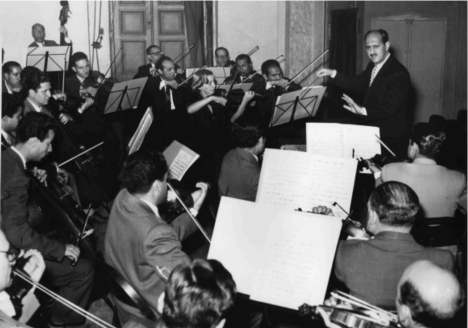
An early Egyptian orchestra composed entirely of male musicians, illustrating the gendered structure of classical music institutions during much of the twentieth century. (El-Shawan Castelo-Branco 2019)
However, access to these spaces was never neutral. Entry required economic stability, family permission, and social legitimacy. And for certain women, these conditions created an additional layer of constraint, even when musical ability existed within themselves.
Like many orchestras in the twentieth century, the Cairo Symphony Orchestra was initially structured through male-dominated orchestral sections and leadership hierarchies. One of the earliest figures to challenge this structure was composer Awatef Abdel Karim. As the first Egyptian woman formally trained in composition, she studied at the Cairo Conservatoire and later became head of its Composition and Conducting Department. Her career marked a foundational institutional shift: women were no longer only performers within the system, but educators and authors shaping its future.
In later generations, composer Mona Ghoneim expanded this trajectory further. Trained in Cairo and Vienna, her work blends Egyptian melodic identity with Western orchestral form. She represents a contemporary model of Egyptian classical composition, one that is both locally rooted and internationally acknowledged.

Image of Composer Mona Ghoneim
Egyptian soprano Amira Selim represents one of the most internationally recognized voices of Egyptian classical music today. Trained at the Cairo Conservatoire and later in Europe, she has performed across major opera stages and gained national prominence following high-profile performances such as the Pharaohs’ Golden Parade.

Image of Opera Singer Amira Selim
Today, Egyptian women are visibly present across orchestras, conservatories, and opera institutions. The Cairo Opera House has become a central space where women’s participation in performance is established. Conservatory pipelines now include significantly higher female participation, especially in piano, strings, and vocal training. International study pathways have also expanded access, allowing Egyptian women to train abroad and return with broader artistic vocabularies and professional mobility.
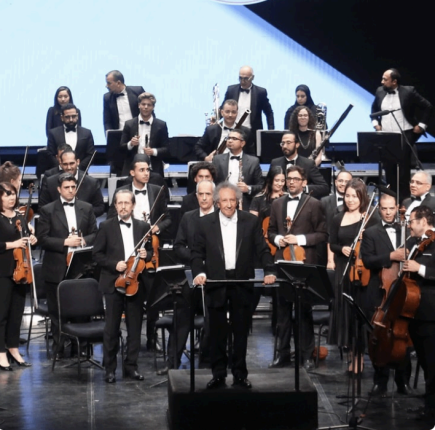
Image of Cairo Opera House
But being present is not the same as shaping the future of the art form.
Women remain underrepresented in composition relative to performance. Conducting remains one of the least gender-diverse roles in classical music globally. And canon formation still lags behind participation, meaning that works by women are less frequently programmed, recorded, or preserved in institutional memory.
What emerges is a persistent gap between participation and definition. Between being heard and being remembered.
When I was younger, I met my own Amira.
It did not happen in a concert hall or an institution. It happened in Faiyum, during a family visit. My mother showed a video of me playing music, and I remember a girl watching it with a kind of intensity that felt almost physical, as if she was not just hearing sound but entering it.
I gave her my piano app. At first she touched it carefully, almost unsure of herself. Then something shifted. She began to play, then to extend what she heard, then to reshape it entirely. What came out was not an imitation. It was something closer to composition, something already forming before language could name it.
I told her she was special.
And later that night, she looked at me and said quietly that no one had ever told her that before.
That is the real story of Egyptian women in classical music.
Not that they are absent.
But that they are still being discovered, again and again, before they are given the chance to become inevitable. The future of Egyptian classical music will not be shaped by whether women can enter the hall. It will be shaped by whether the hall learns to expect them there.

