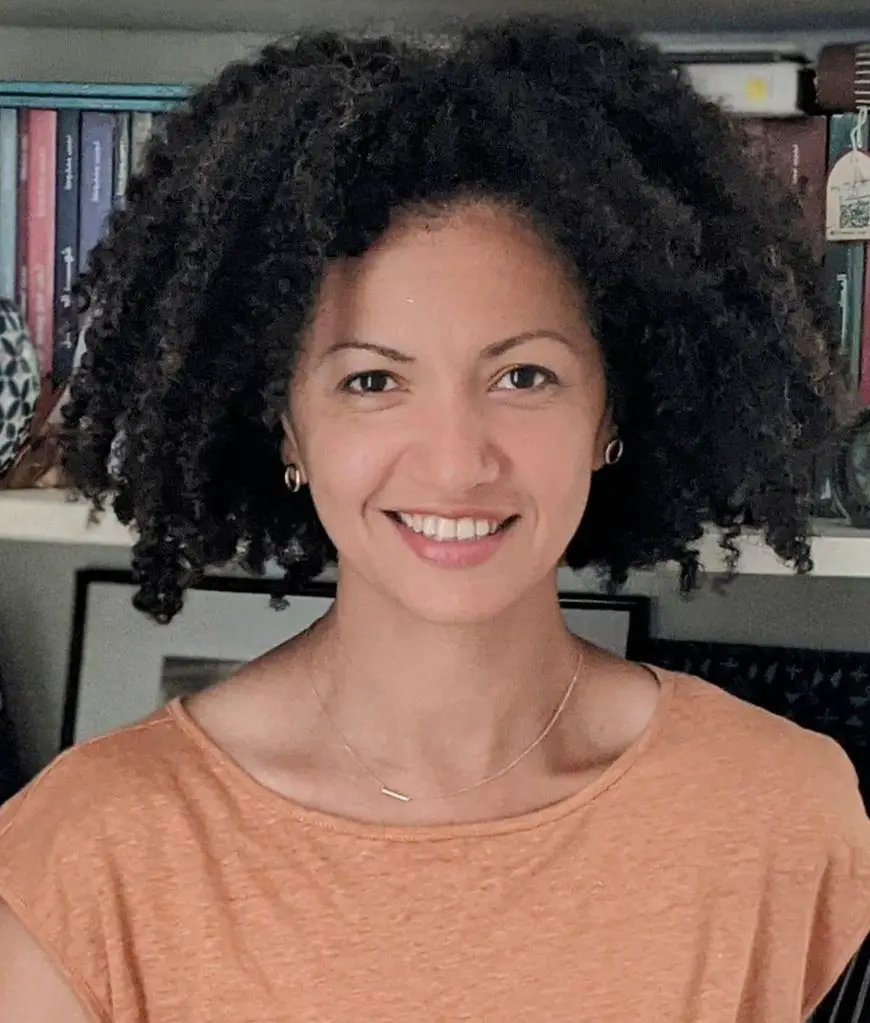
Hadil Ghoneim is a writer. She studied Political Science at Cairo University. After working in cultural journalism for a few years, she earned an MSc in Culture and Society from the London School of Economics.
Hadil Ghoneim moved to the US in 2008 at the age of 32. She was newly-wed. She initially believed her move to the US in 2008 would be temporary, staying only for few years until her husband completed his PhD. Excited for a break from her publishing and journalism career, she immersed herself in student life in Southern California. She took a two-year leave of absence from work, believing they would return to Egypt, and continued to write occasionally for a Cairo-based newspaper.
She continued working on an international research project and wrote a children’s biography of Dr. Ahmed Zewail, who taught on her campus. Despite these achievements, she felt anxious about becoming dependent again as a trailing spouse in the US after achieving career independence in Egypt.
In America, Hadil maintained her Egyptian culture. She learned to cook her and her husband’s favorite Egyptian dishes, celebrating religious and non-religious holidays in the traditional Egyptian way whenever possible. She stays engaged with her favorite Egyptian writers and the cultural and literary scene.
Hadil has a 13-year-old daughter who loves speaking Arabic in the Egyptian dialect. About the challenges she faced raising her daughter in the US, Hadil said, “I was lucky to know some Egyptian families around when my daughter was growing up. That sense of community was crucial in developing a positive relationship with the Egyptian side of her identity.”
Hadil wasn’t able to enroll her daughter in formal Arabic reading and writing classes, but she taught her some basics to build on later. Initially, the daughter had no trouble fitting in at her American school, but as she grew more socially aware, in fourth or fifth grade, particularly during the BLM movement, she began to grapple with her racial identity. Questions emerged about the distinctions between being from an African country like Egypt and being African American, as well as defining “her people” and separating skin color from cultural heritage. Now, she embraces the complexity of her identity and its intersections with different racial and cultural groups in America.
Despite growing up in America, Hadil’s daughter takes pride in her Egyptian heritage. She cherishes the everyday humorous nuances of speaking the language, and has a deep affection for her Egyptian family members and friends. Despite brief visits, she treasures the memorable times spent in Egypt. Hadil believes her strong connection to Egypt and its people has been passed on to her daughter, who now even listens to Egyptian pop music on her own.
Hadil feels it’s important to maintain the Egyptian identity and heritage, “to know oneself, where we came from and what shaped us.” She watches old favorite TV shows and movies. She cooks Egyptian food, celebrates Egyptian holidays, and visits Egypt at least once a year.
Not only that, but for Hadil, Egyptian music is part of her personal consciousness. She launched a “Community Arabic Sing Out” which she organized with fellow Egyptian families for several years until the pandemic hit. They’d choose a theme, select songs, print lyrics, and sing as a group.”It was lovely and uplifting and fed our longing for Egypt.”
Reflecting on her experiences as an Egyptian woman living in the USA, Hadil finds pride in the memory of January 25th Revolution, a symbol of brave struggle for democracy, human dignity, and social equality.
About some of the differences she noticed between life in Egypt and life in the USA, Hadil appreciates the availability of free, well-maintained public spaces such as playgrounds, parks, and libraries in the US, as well as the active involvement of parents in the public school system through organizations like PTOs. This has led her to think how similar approaches could benefit public education in Egypt.
Additionally, while quality goods are affordable in the US, services like hairdressers, drycleaners, house cleaners and cooks, handymen, etc., tend to be more expensive compared to Egypt, leading many Americans to acquire DIY skills for tasks like home repairs.
Hadil hasn’t faced any cultural or societal challenges as an Egyptian woman living in the USA. She attributes that to living primarily in progressive university towns, she considers herself fortunate as most residents are educated and used to diversity.
The cultural transition wasn’t challenging for her either, due to her familiarity with American culture and prior international exposure. However, arriving at an older age, she acknowledges missing or dismissing subtle microaggressions, as she wasn’t attuned to them and didn’t grow up as a minority, thus not deeply affected by them. Her main concern now is her daughter’s upbringing with the awareness of being a minority from childhood.
Since moving to the USA, Hadil takes pride in maintaining her writing career, successfully publishing Arabic books that were well-received in Egypt, “despite the challenges of feeling physically removed from the scene.” This challenge motivated her to write in English, leading her to join writing and reading groups. Additionally, she found joy in articulating her experiences through creative nonfiction essays published in American journals. Furthermore, she started Arabic story time sessions for children at the local public library, which connected her to the larger Arab American community.
She eagerly anticipates the release of her forthcoming book, a bilingual collection of Arabic folktales set to be published in the US next year.
In her view, integrating into society as new immigrants is important to avoid living in isolation within a consumerist bubble, “Finding community is good for mental health and general well-being”
Drawing from her experience, Hadil suggests that volunteering is an effective way of integration, alongside joining interest-based groups and activities. “It shouldn’t all have to be identity-based.”
While cultural heritage can provide comfort, she enjoyed joining various groups such as international student spouses, playgroups and parent groups after having her daughter, writing groups, and tennis groups. Additionally, she has volunteered in interfaith charity activities and anti-war groups as part of her integration journey.
 Women of Egypt Network
Good morning
Thank you for introducing these women to us.
<
div>I live
LikeLike
It was wonderful to read your story. Are your books sold in the U.S.?
LikeLike