
November 7, 2026
By Capri Nasir
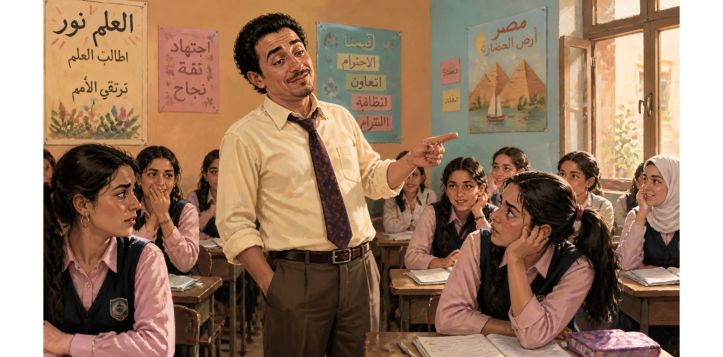
Egyptian schoolgirls deserve an education, not another lecture on why women can’t be equal or better than a man.
There is something particularly ironic about sitting in a classroom, supposedly there to learn, only to find yourself being taught that women are not worth taking seriously.
For young Egyptian girls, misogyny isn’t always something they encounter outside the school gates. Sometimes, it comes from the very people standing at the front of the classroom, marker in hand, explaining history, geography, or whatever subject happens to be on the timetable that day. And somehow, we’re expected to accept it as part of the school experience.
Take, for example, the history teacher whose remarks about two prominent Egyptian historical figures, Huda Sha’arawi and Safiya Zaghloul, sparked controversy across Egyptian social media on October 8, 2026.
During a private tutoring session in Alexandria, a male teacher mocked their feminist legacy, comparing them to television presenter Radwa El Sherbiny. He went on to suggest that women’s involvement in public life and their pursuit of liberation had contributed to society’s downfall. This claim is particularly absurd given the significant role women played in shaping ancient Egyptian civilization.
Now, imagine being a young Egyptian girl sitting in that room, listening to an educator discuss women who fought for the rights and opportunities that generations of girls would eventually inherit, only to hear their legacies reduced to punchlines.
What exactly are these students supposed to take away from that experience? That women’s contributions to history are worth remembering only when convenient? That a woman’s liberation is something to ridicule rather than understand?
And that raises an uncomfortable question: When did being a teacher become an excuse to humiliate the very students you’re supposed to educate?
Let’s be honest, Egyptian girls already have enough to worry about. Thanaweya Amma is practically a national endurance test. Between examination anxiety, family expectations, exhausting tutoring schedules, and the pressure of securing a future through a handful of examination papers, students barely have enough time to breathe.
The last thing they need is another adult using their authority to make them feel smaller.
And before anyone rushes to defend this behaviour with the familiar excuse of “he’s just expressing his opinion,” let’s get something clear: freedom of expression does not mean freedom from criticism.
Teachers are entitled to their opinions, but students are equally entitled to question them.
A classroom should be a place where ideas are challenged, not where young girls learn that challenging a man’s opinion might make them the next target of ridicule.
There’s also something deeply contradictory about teaching history while dismissing the women who helped shape it. Huda Sha’arawi, founder of the Egyptian Feminist Union in 1923, and Safiya Zaghloul, a prominent figure in the 1919 Egyptian Revolution, were not simply women who challenged social expectations. They were historical figures whose contributions deserve serious discussion.
And feminism is not an unclean word that needs to be laughed out of a classroom.
Perhaps the most frustrating part is how easily these incidents become normalised. A teacher makes a misogynistic remark, students laugh awkwardly, some remain silent, and the lesson continues.
Tomorrow, everyone returns to the same classroom, opens the same notebooks, and prepares for the next exam.
But what happens to the girl who disagrees? Does she risk being ridiculed? Does she risk being labelled disrespectful? Does she have to choose between speaking up and maintaining a comfortable relationship with someone who may influence her education?
Why should a teenage girl be expected to respect an educator who doesn’t respect her? An educator who doesn’t even think she belongs there?
Young girls shouldn’t feel uncomfortable in a place they go to learn.
This isn’t an argument against teachers. Quite the opposite. Educators have an extraordinary influence on young people.
The Egyptian poet Ahmed Shawqi once wrote:
“أَعَلِمتَ أشرَفَ أو أَجَلَّ مِنَ الذي
يَبني ويُنشِئُ أَنفُساً وعُقولا؟”
“Do you know anyone nobler than the one who builds souls and nurtures minds?”
And perhaps that’s what students see in some truly inspiring female teachers: a symbol of nurture, wisdom, and encouragement.
Some of the most beautiful things about education happen when a teacher sees potential in a student that she hasn’t yet recognised in herself.
This happens when a female teacher encourages a young girl to pursue her ambitions, introduces her to women who changed history, or simply reminds her that she is capable of more than society expects of her.
There is something particularly powerful about women inspiring other women.
A female student should be able to look at her teacher and see possibility, not another person reinforcing the limitations society has placed upon her.
She should be able to imagine herself becoming a historian, a scientist, a politician, an artist, or perhaps even the woman standing at the front of that classroom, one day.
Teaching should open doors, not quietly remind girls that some doors were never meant for them.
Egyptian girls aren’t asking to be treated like royalty.
They are asking for the same basic respect boys already receive: to enter a classroom without having their intelligence, dignity, or right to an opinion turned into entertainment.
Girls deserve educators who challenge their minds rather than belittle their existence; who teach them history without mocking the women who helped shape it; and who understand that respect is not something students should be expected to give unconditionally when they receive none in return.
So, to the girls sitting in those classrooms, silently questioning what they’ve just heard: you’re not being difficult for disagreeing, you’re not disrespectful for questioning authority, and you’re certainly not asking for too much by expecting to be treated as equals.
We are here to learn. Not to be silenced. Not to be ridiculed. And certainly not to be taught our own inferiority.
Learn, educate yourself, and be certain that you, a strong young woman can become whatever you want in life.

