September 5, 2024
WoEgypt
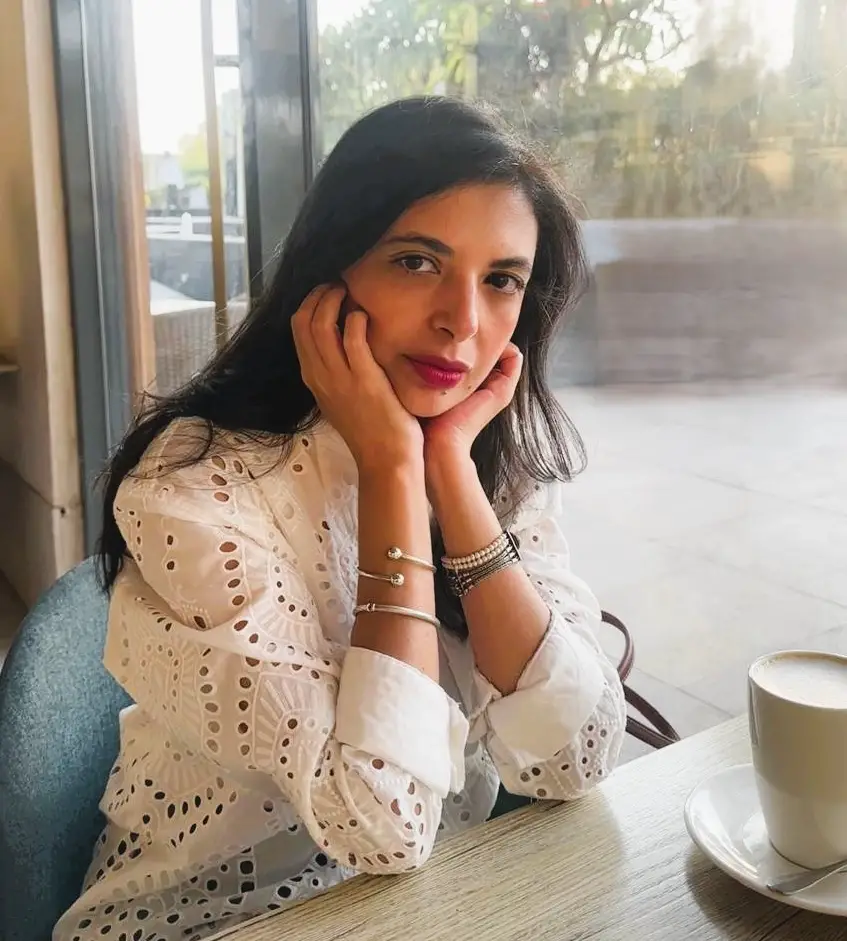
Samar Taher is the writer of the Tv Hit “Alaa Nesbet Moshahda”.
She is a screenwriter and Egyptian Author who received a master’s degree in media and worked as news editor and translator on the Egyptian Radio. She published her articles in several Arabic newspapers, her blog (Letters of Halawa the Cat), which she later turned into a book (Women Who Don’t Eat Shawerma), depicts the relationship between women and men in a humorous way. She also writes short stories, novels and travel literature.
She has written for children and young adults, and held storytelling and reading sessions, which have helped her to learn more about young people’s perspectives on the world.
She also published books for adults, including “Media in the Era of Globalization”, “The Room Ceiling”, “Getting there is half the fun”, and “Screenshot”. She published 40 books in Egypt, Lebanon and Kuwait.
Samar studied acting in “The Actor’s Studio-Studio El Momathel”. Then she studied Scriptwriting at Raafat Al-Mihi Cinema Academy.
This year she wrote the Award winning Tv hit “Alaa Nesbet Moshahda”, and she also co-written many Tv series, one of which is “Bedon Sabeq Enzar”, “This Evening”, “Haza el Masaa”, “Ella Ana”, “Waraq el Tout” which was sponsored by the UNFPA, and the Arabic version of the popular American series “Sesame Street”.
She won the Sawiris Cultural Award for her screenplay “The Inmate-Al Nazeel”.
What was the biggest challenge you faced while writing this multilayered story?
The biggest challenge for me while writing this story was to dig deep into the layers, to go beyond the obvious, and to be honest and humane.
Anyone who wants to weave a story about the world of social media influencers can fall into the trap of judgment, so I chose to write a story primarily about humans, with all their complexities, motives, and fears, my mission was not to criticize nor to direct accusations against the new generation. My story was originally about love, family dynamics, and the generation gap, I tried to shade lights, meanwhile, on the influences of social media on our lives.
I have always been attentive to influences of alternative media on people, since I began my research journey fifteen years ago; my master’s thesis discussed the dilemma of digital gap, and media influences in the era where information flow and information technology became unstoppable. I am concerned about the alternative media influences on societies and cultural identities.
As for the new generation, how were you able to write about them, the details of their lives, and what goes on in their reality in this era?
Usually, in my stories, I pay attention to the young generation and teenagers, and the challenges they face, especially Generation Z.
From my experience, I know that there are major challenges that fall on their shoulders, as they are always criticized for being obsessed with social media, while it is the language of the time; its unescapable. I think the new generations are facing lots of difficulties adapting to those great changes in our daily life in the era of technology.
This is not the first time I have written about the new generation. I have a novel that focuses on the complicated emotions, and individual differences between siblings within the same family, and I have written many children’s stories as well, that was published in Egypt, and other Arab countries. Children and young adults represent an age group I am primarily interested in addressing.
Generational conflict, or the gap between generations, how do you view it, and how did you show it in your story?
That being said, my concern is about the idea that the older generation always accuses the children of being superficial and that their life is meaningless, and each generation accuses the generation following it of being of no use, and other such sayings.
It is normal to happen, but not fair and not accurate though. The same applies to modern art, even some of the most important artists were criticized in the past, and were accused of presenting vulgar art, but after years this art was appreciated.
Does this mean that modern art is always faced by society or the older generations with criticism and rejection?
Usually, most people reject everything new, and a small group accepts innovations, and every innovation is frowned upon until proven otherwise. New things in general make a person confused: how to accept them and how to deal with them. Does accepting them mean changing their usual lifestyle? For a normal man any innovation is an enemy, and the Egyptian writer Abbas Al-Aqqad once said that changing habits is one of the most difficult things for the human soul.
And social media is one of the new variables. It will take years to learn how to deal with it properly, to know its benefits, and avoid its drawbacks on ourselves and our identity.
What are its disadvantages from your point of view?
It is a form of expression, and this is positive, but there are negative sides, but the recipient is exposed to a strong dopamine boost or rush due to short videos. Excessive information, and fast clips, making a sort of dependency. With this great flow, we receive information passively and never get the chance to analyze or process it.
It also exposes young people to cyber bullying, and to feel marginalized sometimes, or competing over superficial values that lead to a fear of missing out; a feeling of alienation and meaninglessness, and this is what concerns me as a writer when we talk about social media, I usually tend to see hidden layers of any social phenomena.
Can social media corrupt people?
I agree that social media sometimes promotes trivial things, but as far as I am concerned it usually can’t alone corrupt a person, it may reflect corruption or any other defect that already exists in a person though, as it is only a mirror of what exists within us.
Even our vision of everything as either black or white, and our vision of all content as either harmful or beneficial, is not an accurate assessment, because there are things that may not be harmful, but they are not purposeful in the understandable sense. They may be just entertaining, and this is something that is also required; there are wide spectrums between both opposites.
So, why are some people too afraid of social media?
Because it gives a channel of expression to all groups or people in different social standards equally, and sometimes intellectuals find that it is their sole right to influence people’s conscience, and that there is only one type of fine art that must be listened to, watched, and received, and that is worldwide.
And also, because this type of media is new, and in general, everything new is rejected at the beginning. For example, at the beginning of cinema, there was silent cinema, where stories were told using video tape only. When sound tape was introduced to cinema, everyone rejected it, because the audience was not accustomed to it, and because the makers and artists thought Sound will reduce the cinematic art that necessarily relies on visual narration through images only. Years passed, films became talkies, and the era of silent cinema ended forever.
Does this apply to underground, or pop art songs?
Folk songs are another example. Some people reject them, then enjoy them, especially in celebrations and weddings, they refuse them not because they are new, but because they have a special nature and are linked to certain groups of society and do not express the middle or upper class.
This duality confuses me, as they are enjoyable creative songs and their melodies often evoke emotions in an aggressive way, and even when I find some meanings in lyrics that belittle women for example, I wonder, do the songs encourage those negative patterns?
My answer is: they may, but they did not create the pattern. They only showed it on the surface.
This art reflects things that sometimes happen among certain groups, and they are patterns that are kept silent about, but that does not mean that they do not exist, only the songs show them and express the people’s feelings.
The existence of these songs is important, not only because everyone has the right to express themselves through art, but also because those songs present, to psychology and sociology researchers, an image of the prevailing patterns in societies throughout the ages.
Are you concerned about the idea of double standards or imbalanced values in general? As a writer, is this reflected in the stories you weave? And how do you see this?
Although the law criminalizes all mistakes, people sometimes does not condemn the wrongdoers, but sympathizes with them, just as people sometimes asks girls to tolerate harassers, while they stand on the lookout for any mistake girls make; Law condemn harassers, but sometimes society do not, simply.
Violation of privacy and bullying through social media are among the most important problems, and they are legally condemned, but society sometimes does not condemn them.
Back to your story and the layers you created, is there a similarity or contrast between the new generation, or the heroines of your story, the three sisters, and the mother and father as you presented them in your series?
The mother and her daughter, Shaima, always try hard for the sake of others; to please them and to improve their lives, ignoring their own needs or personal interests. Despite this, the mother deals with her daughter with some cruelty, because she is the middle one, so she is not spoiled like the younger, nor is she considered an extension of her like the elder; this middle daughter is totally unseen. The mother expresses her love for her in a way of constant criticism, and her goal is to find her a husband, even if he is not suitable, just to place the responsibility of protecting her on the shoulders of anyone else.
I deliberately made the mother make a major mistake; she passed a moral test during the events of the story. Despite her extreme conservativeness, she stole. She made that mistake out of fear and financial need.
As for the father, since I built his character, I gave him a historical background which I revealed in the first episode, when he told his daughter Nessma that he had hoped to become a famous singer, but circumstances did not help him, and thus he is a mirror of Nessma who also wanted to achieve fame, and despite his love for art, he was angry when he found his daughter Shaima singing. All these contradictions are important to present dramatic characters who are real, with gray shades.
The series discussed the idea of songs in general, or “Mahraganat” songs, through the song that Shaima presented during the events, and how the street loved her, but the heroine’s father revolted against her. Do you think that society reject popular art?
Although the heroine’s father wished to become a singer himself, and whether he wanted art for the sake of art itself or for the fame that accompanies it, but he refused what his daughter did, perhaps because she did it in secret, and perhaps because he was convinced to behave in this way in order to become an “Ideal father”; we act sometimes according to standards and values, without questioning what those values are, and because of this, I say that this story in its core is about stereotyping and double standards, and not solely about social media.
Away from social media, you mentioned that your story is about love. How did you see that? What does love mean, to you?
There are many types of love, and from the first moment the heroine or main character of the story seeks love, to be appreciated and to be seen, and these are simple human needs. But she does not feel worthy, because she was subjected to constant criticism, and shame.
How her sister treated her, for me, is a love hate relationship; Nesma loves Shaimaa, but still feels jealous of her, her mother also loved her but couldn’t express her love properly, for that reason she was attached to her uncle who loved her unconditionally.
What did you mean by the end of the story?
The ending is a question, not an answer, I wanted the viewers to think about that family and their dynamics, and to understand their motives and fears.
The story is basically fictional, and the audience has every right to see it and interpret it according to their perspective. The theory of the death of the Author is one of the theories that I believe in.
I see criticism as an essential part of the art creation process, its very beneficial for the writer to listen carefully to different opinions about her or his stories.
And what “The death of Author theory” is about?
The Death of the Author theory argues that the meaning of a text is not determined only by the author’s intention, but rather by the reader’s interpretation. This theory was introduced by French philosopher Roland Barthes.
So, once the story appears to the recipients, it becomes their property; they interpret it as they receive it, not only according to the intentions of the writer.
However, if you ask me about the ending, I will say that the complications that occurred to the main character could have been avoided if there had been a real dialogue within that family. If that dialogue existed at this moment, the heroine would not have escaped her family home and would not have been exposed to all what happened after she got married to a man who used her against the law.
So, the problem did not only start from the screen, but rather from the structure of relationships, pressures, expectations, and power relations within the family, including jealousy between siblings in the first place.
In the end, I chose that some of the characters in the story continued as they were, such as the younger sister Nesma, who began to present other content that she believed would save her from societal blame and condemnation.
The finale, for me, is an invitation to think about all the questions raised during the series, and that is Drama to me, to make the audience rethink and requestion, while enjoying an entertaining simple story.
 Women of Egypt Network