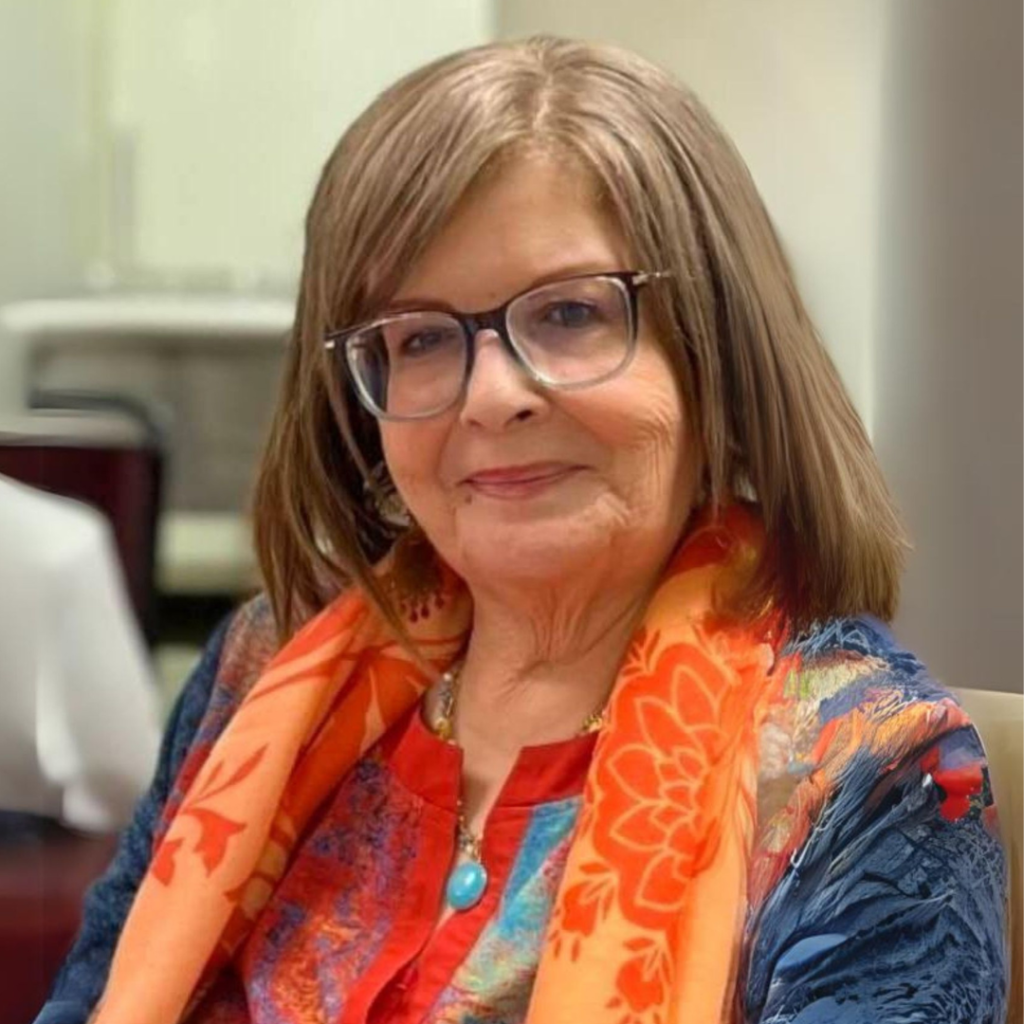
Maha Hammad Zehery, has been in the USA since 1982. Her father served as an Admiral in the Egyptian Navy, while my mother was an educated woman deeply involved in community and in numerous non-profit organizations.
Continuing her mother’s legacy, Maha has been actively involved in community and non-profit work.
She initiated an interfaith group and managed a day center for a prestigious non-profit organization, providing comprehensive services for individuals facing mental health issues, addiction, or homelessness. Serving 60 to 80 clients daily, Maha focused on community engagement to reduce stigma and foster empathy, with the mayor participating in center activities. She also offered diverse classes to empower clients for independent employment, leveraging her PR expertise honed from her early career in an American bank in Alexandria.
Maha has a bachelor degree in Interior Design, and two Masters degrees in Adult Education, and Social Studies.
She moved to the USA in her late thirties after marrying her husband, an Egyptian American citizen with a Ph.D. in computer science who was residing in the US. They met in Cairo, got married, and moved to North Carolina. She had visited the USA a few times before and even attended training while working for Citi Bank. “The transition to the US was enjoyable and smooth for me, and my goal was to provide my kids with the best educational opportunities.”
From the start, Maha made an agreement with her kids to keep their Egyptian good traditions and add to them the American positive ones, but to always be proud of their origin. “We celebrated our Muslim holidays and also enjoyed celebrating Thanksgiving, Christmas and Easter. We also shared with other friends who came from other different backgrounds their holidays,” Maha explained.
Maha has three children: two daughters and one son. Reem is a child psychiatrist, Rana is a graphic designer and vice president at a well-reputed design company, and Omar, who started a successful rock band in the 90s, now runs his own music recording business and is a popular rock star in their community.
Maha describes the challenges of raising her kids as minimal, as she always maintained open communication with them. “They were popular in school and in their various jobs, and they always had diverse friends, just like we did.”
Maha believes it is important to maintain the Egyptian identity and heritage. She and her family proudly talk about their Egyptian heritage, history and culture. They also socialize with many community friends that share their values.
Her kids are proud of both their Egyptian origins and being American citizens as well. They visit Egypt “every- now and then, and we are always in touch with our family and friends that are residing in Egypt.”
She feels very proud and nostalgic when she sees the Egyptian flag or hears the Egyptian anthem, or music. “I grasp every occasion to proudly offer presentations about our heritage, history and family.”
When asked about the biggest differences she found between life in Egypt and in the USA, Maha said, “I always say that most Egyptian are very emotional and most Americans are very practical. I wish we could these qualities to have equal practical and emotional attitudes.”
One of the memorable experiences that highlight the intersection of her Egyptian identity and life in the USA was when she organized a trip to Egypt with 30 American friends. The trip was a great success. They toured Cairo, Alexandria, the Red Sea, and Luxor in Upper Egypt, where the authentic temples, monuments, and monasteries are located.
Among her many accomplishments and successes in the USA, Maha is most proud of obtaining her master’s degree from Ohio State University, “which was a main item on my bucket list,” she says.
Maha considers herself lucky not to have encountered any stereotypes or misconceptions about Egyptian women, attributing this to being surrounded by educated and informed people.
Nonetheless, she recalls two incidents that have been ingrained in her mind. The first incident occurred when she was applying for a job. Despite having an impressive resume, the interviewer, upon learning she was originally from Egypt, said, “I hope you don’t bring your country’s problems with you.” She responded, “I didn’t, as the US has plenty of its own problems and doesn’t need to import any more.”
The second incident occurred when she met a woman who asked about common stereotypes such as camels and Egypt being all desert. Maha invited the woman to her home for dinner. The woman was surprised to see that she knew how to use a fork and knife, had table manners, and did not have a tent in her bedroom, when she asked to see it!
To new immigrants to the USA, Maha advises them to be proud of their own heritage, but also to adapt to the positive aspects of the Amercian culture.
 Women of Egypt Network