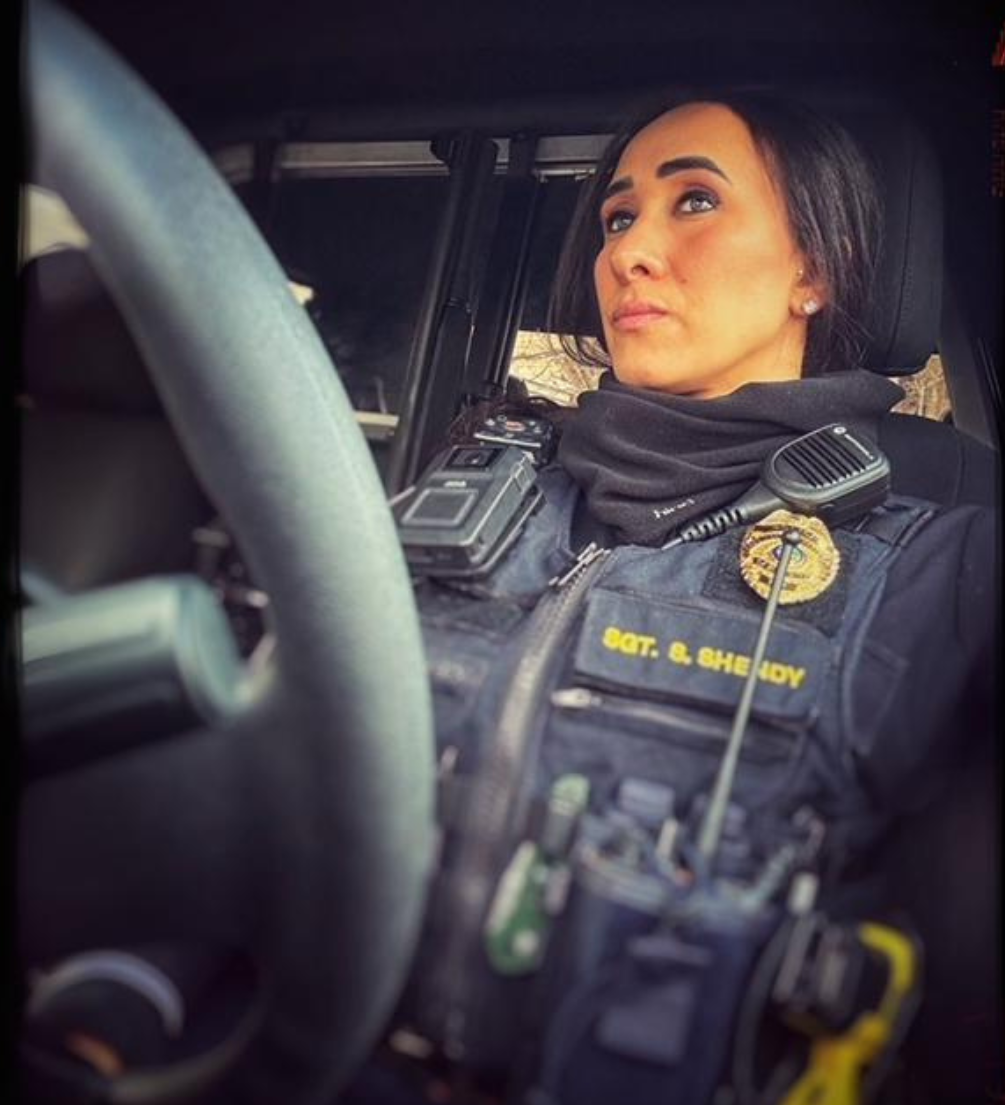
Sarah Shendy is a police sergeant with 16 years on the job. She has a bachelors and master’s degree in criminal justice with a background in juvenile delinquency and global issues. She came to the US at the age of six with her family. “My parents have worked extremely hard their entire life and they took great care of us as a family. We had many challenges, including fitting in at school, assimilating to some of the cultural aspects of living here in America, and establishing a sense of belonging. As an adult, I don’t struggle with any of the challenges that I struggled with as a teenager or a young adult. I’m very intentional about who I am and what I stand for.”
Shendy is extremely proud to be Egyptian. “My ancestors did great things that the world still benefits from today. My family loves to cook and eat Egyptian food, listen to Egyptian music, and we go visit every chance we get. Celebrating our identity is extremely important and is one of many parts. Being in a diverse environment is so rewarding,” she said.
She doesn’t have kids pf her own, but she plays a very active role in the lives of her nieces and nephews. She instills in them the importance of love, kindness, compassion, forgiveness, and inclusion. “I tell them every day how smart and beautiful they are. Any child will believe what they hear every day. Good, bad, or indifferent. We make sure they know our standards and expectations from a cultural and religious aspect while enjoying the privileges that we have access to by living and the United States.”
Her nieces and nephews see how proud their family is to be who they are, and they mirror those behaviors and feelings. They love to dress up and dance to Egyptian music. The family tries to teach them as much as possible about the country, culture, and religion. “I feel so much pride when I see anything at all that’s related to Egypt. The flag, someone’s tattoo, hearing Egyptian music, or even hearing the Egyptian dialect of Arabic. It always makes me feel like home. I feel like I have the best of both worlds because I get to live here amongst really great people and I have been able to achieve so many great things due to opportunities in my past, and I feel extreme pride and belongingness when I am in Egypt or around Egyptian people.”
Shendy believes it is important to maintain the Egyptian identity/heritage. “A lot of people get sucked into feeling the need to be just like everybody around them. This is not something that young adults alone struggle with, but something I see across all age ranges. It is definitely important to maintain our heritage and identity regardless of where we come from. When we are confident about who we are as people, we add value to our communities and places of employment. It is because of us and other immigrant families that people are exposed to things they otherwise would not be exposed to.” She explains.
She and her family celebrate religious holidays. Not much of a cook herself because of her bust schedule, she also enjoys the Egyptian food her mother and sisters prepare. When asked to share a story about a time when she felt particularly empowered and proud as an Egyptian woman living in the USA, Shendy said, “What means the absolute world to me is seeing my parents smile with pride anytime I get recognized for anything. Regardless of how minor or major it was. Joining my current police department has been one of the best things that have ever happened to me. The swearing in ceremony was so special and a core memory for my entire family and everybody involved,” she concludes.
The one thing she most cherishes about her culture and religion is the compassion and empathy that is instilled within her from such an early age. “It comes with a price to pay, and I definitely suffer from compassion fatigue a lot, but it is worth it. I would rather have a bad day and feel sad and upset that someone I know nothing about is going through something terrible, than go on about my day telling myself that other people suffering is none of my business. A lot of things within our culture in the United States tell us and teach us that it’s okay to be more individualistic and I have never agreed with that mindset. I love the hospitality and level of care and compassion that we carry with us everywhere we go. It’s what lead to the majority of my success and as officer.”
Shendy has faced many challenges not only as a Egyptian woman living in the USA, but also being in police work. “Women in law enforcement experience enough challenges as it is, add to that identifying with two groups that are often time mislabeled and judged. Being a Muslim female and identifying as an Arab American female has caused others to not want to support me, become fearful of my potential, and cause or create confusion when it comes to what I stand for.”
“I also have similar challenges being a police officer within a Muslim and Arab American community. I have encountered many people, primarily men, that do not favor interacting with a female officer in a position of leadership or authority. While some people think that I have a lot to offer and teach their kids, other people feel that my way of life and thinking is not ideal and doesn’t represent our culture and standards. It makes me sad to say this, but a lot of people from the Arab American and Muslim community cannot see past the uniform and don’t consider me one of them. It is hard for them to understand that I am a Muslim Egyptian female that is also a police officer. And their mind, I have to be one or the other.”
In reflecting on the intersection of her Egyptian identity and life in the USA, one memorable experience stands out: the ability to assist numerous individuals in terms of healing, recovery, and navigating the criminal justice system. Her understanding of religion, culture, and the criminal justice system itself has empowered her to provide effective support. Many crime victims, especially women, often hesitate to engage with law enforcement after traumatic incidents. The presence of an officer who speaks their language, shares their beliefs, and comprehends cultural nuances can significantly reduce barriers in the process, benefiting both the survivor and the police agency.
Among her many accomplishments, Shendy is most proud of receiving the 40 Under 40 Award from the International Association of Chiefs of Police (IACP) and being recognized among the 40 Under 40 by the Arab America Foundation.
Shendy has encountered stereotypes or misconceptions about Egyptian women in the USA. “People think that we are oppressed, dependent, and not always educated. When the exact opposite is true. We are very liberated, independent, and education is a top priority in our culture and families. Stereotypes exist due to everything that we are exposed to in our environment. That’s why having conversations with people who are very different from you is important. It helps shape how we think and distinguish facts from fiction.”
She believes it is important for new immigrants to integrate and assimilate into society without sacrificing who they are as individuals. “That’s what makes this country so special. I would say that we can accomplish integration and assimilation by doing what works for you and your family. This is not a one size fits all.” She also emphasizes the importance of parents listening to and understanding their children when they want to do certain things or engage in activities that they see their friends doing. “Instead of saying “no” and shutting down the conversation, having an open dialogue and being willing to compromise is key.”
Shendy hopes to live to see the day when more Arab Americans join the profession of policing. It is such a noble and honorable position to be in. We truly have the potential to change people’s lives. The way that we are raised, primes us to be great public servants. There is so much to fall in love with about the job. I feel that our Arab- American and Muslim communities here in the United States need to show more of an effort to when it comes to partnering with and working with police agencies. I understand that some communities do a great job, but from where I am sitting, a lot of Arab American cultures and institutions could be doing better. I give the same advice to law enforcement agencies regarding the Muslim and Arab – American communities. The safety of our children and communities team effort. It is all hands on deck. We need to put aside all of the stereotypes that we are fed, the negative and bias stories that we see and hear via some media sources, and treat each other as individuals. More cohesion could be accomplished if we operated in that manner,” she concludes.
 Women of Egypt Network