
How Digital Beauty Is Changing the Way We See Ourselves
August 20, 2026
Kismet Mokhtar
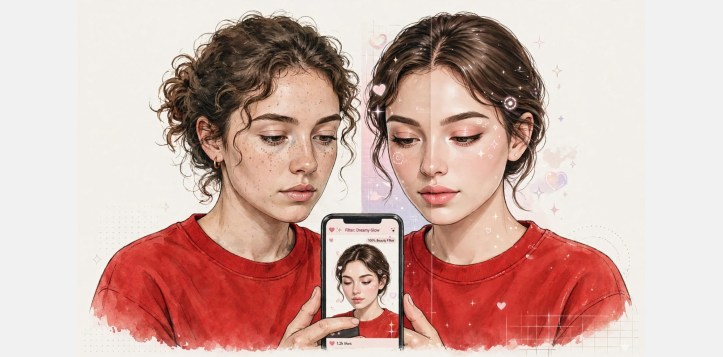
When photo filters first appeared, they were simply a way to add a touch of beauty to a picture—improving the lighting, adding a warmer tone, or creating an artistic effect that made the photo more appealing.
But as social media platforms evolved, filters stopped being just tools for editing photos. They became capable of changing the face itself—making the nose smaller, the eyes larger, the lips fuller, the skin smoother, wrinkles disappear, and even the shape of the jaw and cheeks change.
The question is no longer, “Do you use a filter?”
It has become: “Can you post a photo without one?”
And that is where the story begins.
A woman takes a photo of herself and adds a filter that makes her skin look clearer, her eyes wider, and her features more symmetrical. She posts the picture, and soon the likes and comments start pouring in, praising how beautiful she looks.
But the problem is not the posted photo itself. The problem begins when she later looks at her real face and feels that it is less beautiful than the edited version.
Over time, women may stop comparing themselves only to other women and start comparing themselves… to themselves.
To the version of themselves created by technology.
If we scroll through social media accounts, we may notice something strange: faces are beginning to look alike.
The same nose.
The same lips.
The same cheeks.
The same flawless skin.
As if there is one single template for beauty, and everyone is trying to get closer to it.
The little details that once made every woman different and unique are disappearing—the freckles, smile lines, fine wrinkles, and individual facial features… all the things that give a person character.
It is as if we have replaced real beauty with a standardized digital image.
It is easy to blame women for using filters, but the reality is much more complicated. Many women do not use filters because they dislike the way they look. They use them because they live in a digital environment that imposes almost impossible standards.
The images they see every day are edited.
Celebrities use filters.
Content creators use them.
Even their friends use them.
So a woman may begin to feel that posting a natural photo will make her look less beautiful than everyone else, even though everyone is using the same tools.
Little by little, using a filter becomes the norm, while showing a natural face becomes the exception.
And we cannot ignore the enormous pressure women face online.
A sarcastic comment about wrinkles.
A remark about dark circles.
Criticism about weight.
Mockery of skin, hair, or age.
These comments may seem harmless to some, but they can push many women to search for a “more acceptable version” of themselves before posting a photo.
The irony is that a woman may be criticized for appearing without a filter, and then mocked when people discover that she uses one.
As if she is expected to be perfect… without anyone seeing her trying to achieve that perfection.
The issue becomes even more concerning when we talk about teenage girls.
A thirteen- or fourteen-year-old girl may spend hours every day on social media, looking at thousands of faces that appear perfect.
She does not see the filters.
She does not see the editing apps.
She does not see the dozens of photos that were deleted before the final one was chosen.
All she sees is “beauty.”
And she may begin to believe that this is what a normal face is supposed to look like.
Over time, she may become dissatisfied with her natural features, even though she never saw anything wrong with them before.
This is when technology can begin to change the way we see ourselves.
Numerous studies suggest that heavy use of beauty filters may be associated with greater dissatisfaction with appearance and increased social comparison, particularly among teenage girls and young women.
At that point, the filter is no longer simply a tool for improving a photo. It becomes a tool that can influence the way a person sees herself.
Some people become so accustomed to seeing their faces through filters that they feel uncomfortable when they look in the mirror.
Not because they have changed…
But because their expectations have changed.
And this raises an important question: Has natural beauty become not enough?
Years ago, a beautiful photograph might have meant a genuine smile or a happy moment.
Today, for many people, a “successful” photo has become one that comes closest to perfection.
But real beauty was never meant to be free of imperfections.
Wrinkles tell stories about age.
Freckles make one face different from another.
And an imperfect smile can be warmer than any filter.
Perhaps these are the details that make us human.
At the same time, not every use of filters is a problem.
A woman may use a filter to improve the lighting, hide the signs of a tiring day, or simply because she enjoys visual effects.
There is nothing wrong with that.
The problem begins when the filter becomes a condition for seeing ourselves as beautiful.
When we lose the ability to accept our real appearance.
And when our real face starts to look strange to us.
There is another side of the story that we do not talk about enough: the connection between filters and digital violence.
Digital violence is not limited to bullying or direct abuse. It can also include an environment that makes women feel they have to alter themselves in order to avoid criticism.
When a woman is attacked because of her appearance, age, skin color, or weight, the message she receives is clear:
“Change yourself so you can be accepted.”
In this way, filters can sometimes become a response to constant digital pressure, rather than simply a beauty choice.
And it does not stop there.
The more a woman feels that she is not enough, the more likely she may be to look for a new beauty product, consider a cosmetic procedure, or subscribe to an app offering even more editing tools.
There is an entire industry that benefits from our constant feeling that we need a “better version” of ourselves.
Yet the truth is that much of what we aspire to look like… does not actually exist.
It is the product of photo-editing software and artificial intelligence.
Perhaps, then, we do not need to declare war on filters or ask women to stop using them.
Maybe we simply need a different kind of filter…
A filter that removes comparison.
One that reduces the pressure of impossible standards.
One that reminds us that a person’s value is not measured by the number of likes, the smoothness of their skin in a photograph, or facial features designed by an algorithm.
Because the most beautiful thing about a person is not that they look perfect…
It is that they look real.
And perhaps the question we should be asking ourselves today is not:
“Which filter makes my photo look better?”
But:
“Can I still love the way I look… without any filter?”


[…] PreviousWhen the Filter Becomes the Mirror […]
LikeLike